
Look, can we just be real for a second? We’re all scrolling through Instagram at 11 PM, seeing someone’s “transformation Tuesday” post, and thinking “wow, I need to get my life together.” I’ve been there. We’ve ALL been there. But here’s the thing about body goals – they’re everywhere online, and honestly, it’s getting really complicated to figure out what’s actually achievable versus what’s been filtered, edited, and curated within an inch of its life.
So let’s have an honest conversation about body goals, fitness, and how to actually get results without losing your mind (or your money) in the process. Trust me, this is gonna be worth your time.
- Deciphering the Concept of "Body Goals" and Social Media's Influence
- The Science-Backed Roadmap: Integrated Diet, Exercise, and Consistency
- When Body Goals Have Real-World Stakes: A Case Study
- Adopting a Healthier Mindset: Body Positivity, Neutrality, and Recovery
- Conclusion: Transforming Your Body is a Holistic Journey
Deciphering the Concept of “Body Goals” and Social Media’s Influence
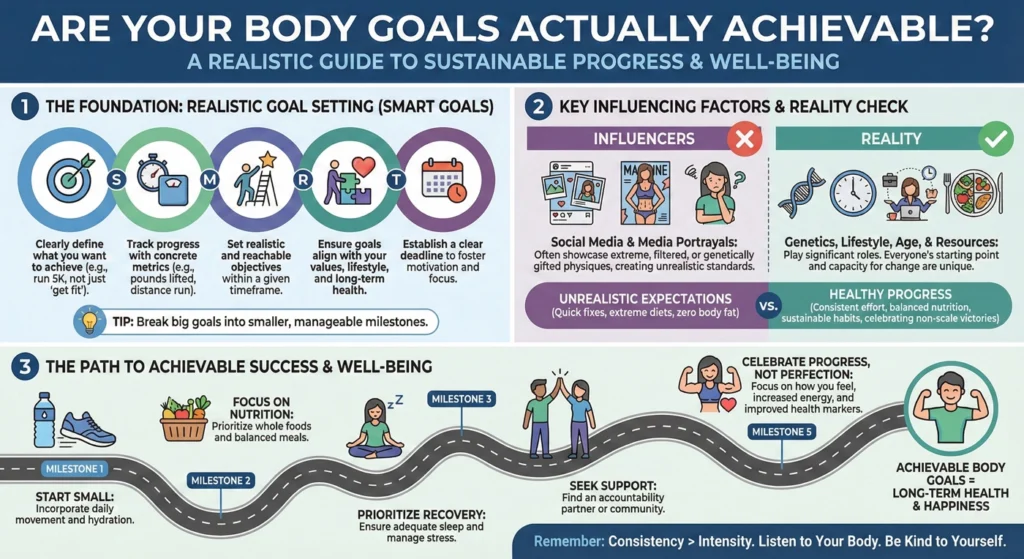
Defining Body Goals and Their Common Misconceptions
Okay, so what exactly ARE body goals anyway? At their core, body goals are just specific fitness, wellness, or aesthetic targets you’re aiming for. Maybe you want to lose a few inches around your waist, build some lean muscle so you don’t feel like a noodle, or finally fix that slouchy posture from sitting at your desk all day. Simple, right?
But here’s where it gets messy. In the influencer world, body goals have become this whole production. You’ve got people sharing their workout routines (usually at 5 AM because apparently successful people don’t sleep?), posting progress photos with perfect lighting, sharing their meal prep Sunday spreads, and basically making it look like achieving your dream body is as easy as following a 12-week plan and drinking green smoothies.
And honestly? That’s kind of BS.
Here’s a huge misconception I need to call out – body goals aren’t JUST about looking perfect. I mean, what even is perfect? Seriously, think about it. The “ideal” body changes every decade. Remember when heroin chic was a thing in the ’90s? Then it was all about curves in the 2010s. Now we’re in this weird place where everyone wants a tiny waist but also a big butt, which is… anatomically confusing.
The truth is, a lot of creators (the good ones, anyway) are actually focusing on performance, mobility, or mental well-being instead of just aesthetics. Like, can you carry your groceries without feeling like you’re gonna die? Can you play with your kids without getting winded? Can you touch your toes? Those are wellness goals that actually matter.
The whole pursuit of an “ideal” body is basically a total fallacy because beauty standards are constantly changing and, let’s be honest, mostly unrealistic. What’s considered beautiful is literally just marketing and cultural trends. Wild, right?
The Dual Impact of Instagram and Blogging Culture
Now, don’t get me wrong – I’m not saying social media is the devil. Platforms like Instagram can be amazing for raising awareness, connecting with people, and expressing yourself. There are artists uploading their illustration work, small businesses finding customers, and communities forming around shared interests. It’s pretty cool when you think about it.
BUT (and this is a big but), social media also has a dark side when it comes to body goals women and men are chasing. These platforms frequently reinforce unrealistic beauty standards and basically bombard us with content that’s been filtered, edited, and curated to show only the highlight reel.
This constant media exposure isn’t just annoying – it’s actually contributing to real body dissatisfaction and mental health issues. We’re talking anxiety, depression, eating disorders, and this pervasive feeling that you’re not good enough. And that sucks.
Here’s what I’ve learned: you gotta remember what’s real. Choose your role models carefully. If someone’s entire identity is their abs and they’re constantly selling you teatox products, maybe they’re not the best person to follow for fitness advice. Just saying.
And please, PLEASE, avoid chasing dreams or lifestyles that exist solely on Instagram. That person’s life isn’t as perfect as their grid suggests. I promise.
The Science-Backed Roadmap: Integrated Diet, Exercise, and Consistency
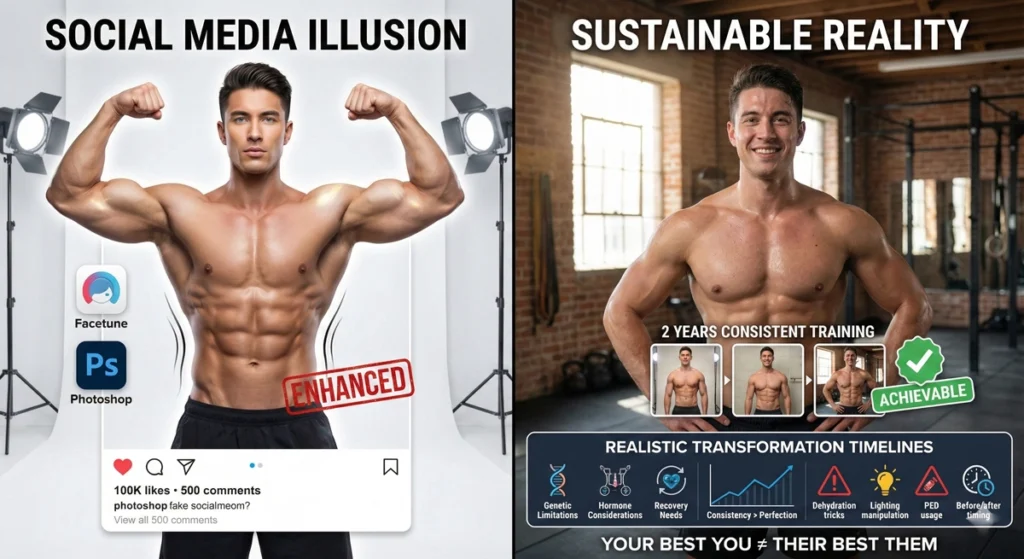
Alright, let’s get into the actual good stuff – the things that ACTUALLY work.
Why Diet and Exercise Must Work Together for Optimal Results
You know how people are always arguing about whether diet or exercise is more important? Like it’s some kind of competition? Well, plot twist: they both matter, and they work best together. Shocking, I know.
Here’s the deal – a well-structured plan that combines both diet and exercise is the key to long-term success. Trying to do just one or the other is like trying to clap with one hand. Technically possible, but why make it harder on yourself?
When you combine proper nutrition with solid workouts, you get this magical synergy thing happening:
- Faster fat loss WITHOUT losing muscle (because nobody wants to be skinny-fat)
- Better workout performance – more energy, more strength, better endurance
- Long-term sustainability so you’re not stuck in that awful yo-yo dieting cycle where you lose 10 pounds and gain back 15
Think of diet as your foundation. It’s what fuels your workouts, helps your body recover, and maintains the calorie deficit you need for fat loss. You can’t out-exercise a bad diet, no matter how many burpees you do. Trust me, people have tried.
Key Nutritional Strategies for Body Transformation
Okay, nutrition time! Don’t worry, I’m not gonna tell you to eat nothing but chicken breast and broccoli. That’s miserable, and life’s too short.
Prioritize Protein
First things first – protein is your best friend. It’s crucial for building muscle, and it keeps you full for way longer than carbs do. This is critical when you’re trying to lose fat because hangry you is not fun for anyone.
Here’s where the science gets really interesting. Research shows that targeting around 1.6 to 2.2 grams of protein per kilogram of body weight isn’t just bro-science – it’s backed by something called the Protein Leverage Hypothesis. Basically, your body prioritizes getting enough protein, and if your diet is diluted with too many fats and carbs, you’ll end up overeating just to hit your protein targets. Plus, protein has this amazing metabolic advantage: 20-30% of the calories you eat from protein are actually burned during digestion (that’s the Thermic Effect of Food), compared to basically nothing for fats.
So for a 200-pound person, that’s roughly 145-200 grams of protein daily.
Aim for lean sources like chicken, fish, eggs, Greek yogurt, or if you’re plant-based, stuff like lentils, tofu, and tempeh. Your body will thank you.
Choose High-Fiber Foods
Fiber is like the unsung hero of nutrition. It stabilizes your blood sugar (so you don’t get those crazy energy crashes), keeps you feeling full, and honestly just makes your digestive system happy.
Load up on:
- Vegetables (broccoli, spinach, Brussels sprouts – yeah, the stuff you hated as a kid)
- Fruits (raspberries, apples, pears)
- Whole grains (oats, quinoa, brown rice)
And stay away from refined grains. White bread and sugary cereals will spike your blood sugar faster than you can say “insulin response.”
Include Healthy Fats
Okay, so remember when everyone thought fat was evil? Yeah, that was wrong. Healthy fats are essential for joint health, hormone balance, and actually absorbing certain vitamins.
Good sources include:
- Avocados (obviously – it’s 2025, we all love avocados)
- Salmon and other fatty fish (hello, Omega-3s!)
- Olive oil, nuts, seeds
Just don’t go crazy – fats are calorie-dense, so a little goes a long way.
Hydration is Key
Water! Boring but crucial. Dehydration can slow down your metabolism, make you hungrier (sometimes you’re just thirsty but your brain thinks you need a snack), and cause bloating.
Aim for at least 8 glasses a day, more if you’re working out hard or it’s hot outside. And no, coffee doesn’t really count, sorry.
Calculate Your Actual Energy Needs
Here’s something most people get wrong: they wildly overestimate how many calories they’re burning. A lot of people hit the gym for an hour and think they’re “moderately active,” but the other 23 hours of the day they’re sitting at a desk. That gym session doesn’t magically turn you into an athlete for TDEE calculation purposes.
Using something like the Mifflin-St Jeor equation (which is more accurate for people who are overweight) with a “Sedentary” or “Lightly Active” multiplier gives you a realistic baseline for calculating your caloric deficit. Being honest about your actual activity level is way more effective than inflating your numbers and wondering why you’re not seeing results.
Developing a Strategic and Consistent Workout Plan
Now for the fun part – working out! But before you go crazy and sign up for a million fitness classes, let’s talk strategy.
Your workouts need to be tailored to your specific body goal. Are you trying to lose weight? Build muscle? Just get generally fitter so stairs don’t feel like a personal attack? Different goals need different approaches.
For most people, a balanced approach works best:
Strength Training (3-4 times per week)
This is where you build muscle and raise your metabolism. And no, ladies, you won’t get “bulky” – that’s a myth that needs to die. You’ll get stronger, more toned, and your body will burn more calories even at rest. Win-win.
HIIT (2-3 times per week)
High-Intensity Interval Training is amazing for burning maximum calories in minimum time. We’re talking 20-30 minute workouts that leave you sweaty and accomplished. Perfect for busy people.
But here’s the most important thing: consistency is key. You can’t work out for two weeks, see no results, and give up. Your body needs time to adapt. Stick with your plan for at least a month before you start changing things up.
And if you’re working with a trainer or fitness professional, remember that individualized training plans are way better than those cookie-cutter “one-size-fits-all” programs. Your body is unique, your goals are unique, and your plan should be too.
If you’re wondering how to calculate goal body weight, don’t just pick a random number. Work with what’s healthy for YOUR height, frame, and body composition. There are calculators online, but honestly, how you feel and perform matters more than what the scale says.
When Body Goals Have Real-World Stakes: A Case Study
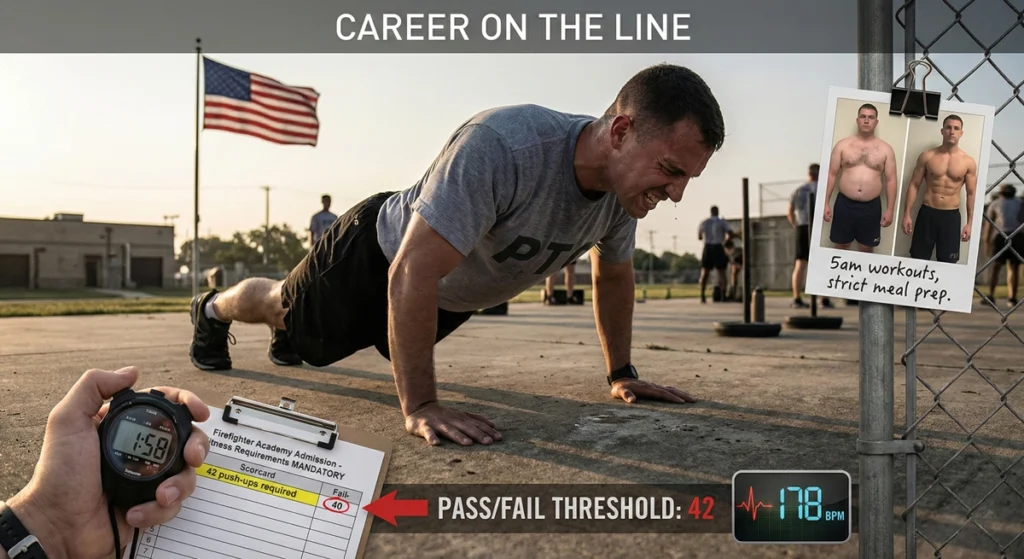
Now, I want to share something that really puts all this in perspective. Most of us are pursuing body goals for personal reasons – we want to feel good, look good, be healthy. But for some people, body composition isn’t just a personal goal; it’s literally a job requirement with massive financial implications.
Take military personnel, for example. Members of the U.S. Navy are subject to strict Body Composition Assessment standards that directly impact their career retention, promotion eligibility, and retirement benefits. We’re talking about a Federal Employees Retirement System (FERS) pension that’s calculated based on years of service and salary. Failing these assessments can result in administrative separation, which can completely derail decades of career building and eliminate pension benefits worth tens of thousands of dollars annually.
Here’s what’s fascinating: the Navy doesn’t actually measure body fat in the clinical sense. They measure geometry using something called the “Tape Test” – circumference measurements of your neck, waist, and height plugged into mathematical formulas. And here’s the kicker: the rounding rules are deliberately designed to favor retention. Neck measurements round UP (a larger neck lowers your calculated body fat percentage), waist measurements round DOWN (smaller waist, lower body fat), and height rounds UP (taller height, lower body fat calculation).
A service member with a 17.1-inch neck and 36.4-inch waist gets recorded as having a 17.5-inch neck and 36.0-inch waist. That bureaucratic adjustment can artificially lower the body fat estimate by 1-3 percentage points compared to raw data.
So you end up with this interesting situation where someone might actually be 28% body fat according to a DEXA scan (the clinical gold standard), but they pass the Navy’s test at 24% because of how the measurements are taken and rounded. The bureaucratic goal is met, the career is preserved, and the pension remains on track – even though the “actual” body composition might tell a different story.
This reveals something important: measurement matters, and the tools we use to assess progress aren’t neutral. Consumer bioelectrical impedance scales (those fancy bathroom scales that claim to measure body fat) are notoriously inaccurate – hydration status alone can swing the reading by several percentage points. You might be dehydrated after a workout and suddenly the scale says you gained 3% body fat overnight, which is physiologically impossible and just demoralizing.
The lesson here? Train to the test. If you’re trying to pass a specific assessment (whether it’s military standards, a bodybuilding competition, or just fitting into your favorite jeans), understand exactly how that assessment works and optimize for those specific metrics. Don’t get distracted by other measurement tools that aren’t relevant to your actual goal.
And here’s something that applies to everyone, military or civilian: there’s often a strategic advantage to building neck and shoulder musculature while reducing waist circumference. Mathematically, increasing your neck measurement has roughly the same impact on tape test results as decreasing your waist measurement – but neck training is often easier and more sustainable than trying to spot-reduce abdominal fat (which isn’t really possible anyway).
The bigger philosophical point is that “passing the test” isn’t always the same as “optimal health,” and you need to be clear about which goal you’re actually pursuing. Military standards allow men over 40 to be up to 26% body fat, but health organizations like ACE categorize anything over 25% in men as entering the “obese” range. The military standard is a “maximum allowable” for retention, not an aspirational health target.
Adopting a Healthier Mindset: Body Positivity, Neutrality, and Recovery
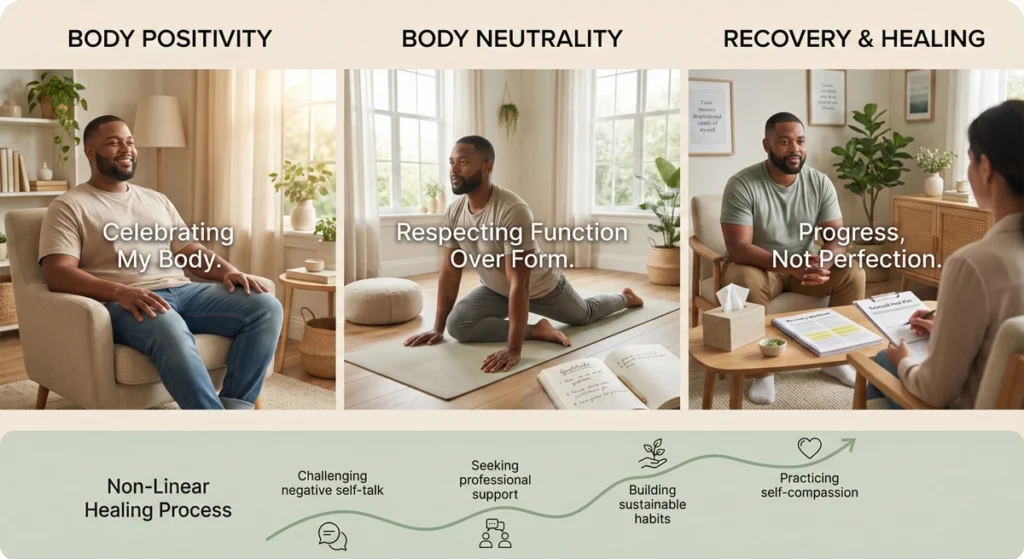
Here’s where we get a bit deeper, because honestly, mindset might be even more important than what you eat or how you work out.
The Power of Body Positivity and Body Neutrality
Have you heard of the Body Positivity (BoPo) movement? It’s all about accepting and celebrating ALL body types. Like, actually all of them – not just the “acceptable” slightly-curvy-but-still-thin bodies that brands love to market as “diverse.”
Research actually shows that exposure to body-positive content on social media can significantly improve body appreciation and satisfaction in the short term. When you see diverse body representations that actually look like real humans, it helps combat that narrow idea of what’s “acceptable” that traditional media has been pushing forever.
But there’s also Body Neutrality, which is kind of a different vibe. Instead of saying “love your body!” (which can feel forced when you’re having a bad body image day), it’s more like “your body is just your body, and its main job is to keep you alive and functional.” It reduces body dissatisfaction without the pressure to actively LOVE everything about yourself all the time.
Both approaches are valid, and honestly, whichever one resonates with you is the right one.
Prioritizing Recovery, Rest, and Mental Wellness
Can we talk about how rest is seriously underrated? Everyone’s all hyped about grinding and hustling, but recovery and rest are just as important as your actual workouts. Maybe more important.
Get 7-9 hours of sleep. I know, I know, you’re busy. But poor sleep leads to higher cortisol levels (that’s your stress hormone), which can actually cause fat storage around your midsection. Plus, you’ll be tired and cranky and more likely to make poor food choices.
Manage your stress. Try meditation, deep breathing, going for walks, or whatever helps you chill out. Chronic stress will sabotage your results faster than you can imagine.
And here’s something cool – more men’s health publications are getting real about mental health and prioritizing happiness over just having abs. Exercise isn’t just about looking good; it’s legit mental health support. It reduces anxiety, helps with depression, boosts your mood, and gives you this sense of accomplishment that carries over into other areas of your life.
Setting SMART Goals and Practicing Self-Discipline
Okay, time for some goal-setting real talk. If your body goal is just “get fit” or “lose weight,” that’s too vague. You need SMART Goals – Specific, Measurable, Achievable, Relevant, and Time-bound.
Instead of “get stronger,” try “deadlift 200 pounds within 16 weeks” or “gain 5 pounds of muscle in 12 weeks.”
Body transformation requires dedication, patience, and perseverance. It’s not gonna happen overnight, no matter what that ad for the latest fitness program promised you. You need self-discipline and vigilance for long-term body management.
But don’t confuse discipline with punishment. You’re not depriving yourself or suffering – you’re making intentional choices that align with your goals. Big difference.
Conclusion: Transforming Your Body is a Holistic Journey
Look, here’s the bottom line: transforming your body is a holistic journey, not a quick fix. Anyone who tells you different is probably selling something.
It requires dedication to strategic exercise, proper nutrition, sufficient rest, and a positive mindset. All of these things work together. You can’t just nail one and ignore the others.
Focus on internal measures of health like how you perform, how you feel, and your mental clarity. The aesthetic stuff will follow, but it shouldn’t be your only measure of success.
And whether you’re pursuing your own body goal or creating content to help others pursue theirs, maintain transparency. Be real about what works, what doesn’t, what’s hard, and what’s realistic. The stakes might be as simple as wanting to feel confident at the beach, or as serious as maintaining a career and securing a pension. Either way, your goals are valid, and the approach is fundamentally the same: understand exactly what you’re measuring, optimize for those specific metrics, and don’t get derailed by irrelevant data or unrealistic comparisons.
With the right approach and maybe some expert guidance, you absolutely can achieve sustainable, rewarding fitness goals that actually transform your life – not just your Instagram feed.
Now stop scrolling through fitness influencer accounts and go do something that gets you closer to YOUR goals. Whatever those may be. You got this!
References:
- Navy Personnel Command. Guide 4: Body Composition Assessment (FEB 2025).
- Protein Leverage and Weight Loss Maintenance. (PMC, 2024).
- Accuracy of Circumference-Based Body Fat Assessment. (Military Medicine).
- OPM. FERS/CSRS Annuity Computation.
- Mifflin-St Jeor Equation for Resting Metabolic Rate.
- Pentagon Guidance on Fitness Standards (2025).