
Okay, so here’s the thing—I used to be obsessed with my scale. Every morning, I’d step on it and let that little number dictate my entire mood for the day. Sound familiar? But here’s what nobody tells you: that number is basically lying to you. Or at least, it’s not giving you the full story.
Let me break down what body fat percentage (BF%) actually is. It’s super simple, really—it’s just the ratio of fat in your body compared to everything else. And by everything else, I mean your organs, muscles, bones, and all that water you’re supposed to be drinking (but probably aren’t, let’s be honest).
Now, here’s where it gets interesting. You’ve probably heard about BMI, right? That outdated calculation that tells muscular athletes they’re “at a higher weight”? Yeah, that thing. Well, turns out body fat percentages are a stronger predictor of 15-year mortality risk than BMI scores. That’s not me making stuff up—that’s actual science telling us that BF% gives you a way clearer picture of your health and fitness progress.
So in this post, I’m gonna walk you through everything you need to know. We’re talking authoritative ranges from actual sports medicine pros, how to actually measure this stuff accurately (spoiler: those bathroom scales aren’t as reliable as you think), and some real strategies backed by sports nutrition research to lower body fat percentage if that’s your goal.
Ready? Let’s dive in.
Understanding Body Fat: Beyond the Scale
What is Body Composition and Why Does BF% Actually Matter?
Alright, so body composition is basically what your body is made of—the breakdown between fat, muscle, bone, organs, and water. It’s what influences your fitness level and how your body is structured. Pretty straightforward, right?
But here’s something most people don’t realize: fat isn’t the enemy. I know, I know—that sounds weird when we’re bombarded with “fat-burning” this and “fat-blasting” that. But stick with me here.
There are actually two types of fat: essential fat and stored fat. Essential fat is literally what keeps you alive. It provides energy stores and protects your internal organs like a built-in bubble wrap. Women naturally need more fat than men—it’s just biology. Women typically carry and require more fat, often storing it around the hips, thighs, and chest (thanks, evolution). Men tend to store fat in the midsection and chest instead.
And here’s the kicker that sold me on tracking body fat percentage instead of just weight: body fat more accurately predicts heart disease and death risk compared to BMI. Like, significantly more accurate. So if you care about living longer and healthier, this is the metric you want to pay attention to.
BF% vs. BMI and FFMI: What’s the Difference?
Let me give you a quick comparison that’ll make this crystal clear:
BMI (Body Mass Index):
- What it measures: Weight relative to height
- The problem: Doesn’t distinguish between fat and muscle
- Real-world issue: Can classify bodybuilders as “having a higher weight”
- Usefulness: Limited, honestly
Body Fat Percentage (BF%):
- What it measures: Actual proportion of fat vs. everything else
- The advantage: Tells you what’s actually happening with your body composition
- Real-world benefit: Tracks actual fat loss, not just weight loss
- Usefulness: Way more valuable for health and fitness
FFMI (Fat-Free Mass Index):
- What it measures: Lean muscle mass relative to height
- The advantage: Helps you set realistic muscle-building goals
- Real-world benefit: Shows if you’re gaining muscle or just gaining weight
- Usefulness: Great for strength training enthusiasts
FFMI is basically a scientifically validated way to measure how much lean muscle you’re packing relative to your height. If you’re into building muscle, this number becomes your new best friend.
Accurate Measurement Methods and Tools
7 Ways to Measure Body Fat Percentage (And Which Ones Actually Work)
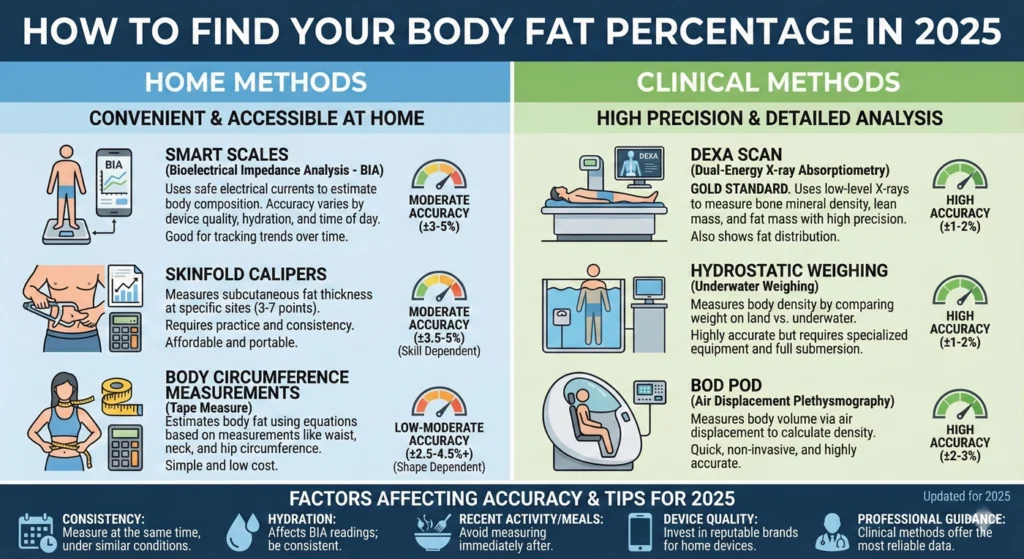
Okay, so you’re probably wondering, “How do I actually calculate body fat percentage?” Great question. There are actually several methods, and they range from “free but kinda sketchy” to “super accurate but you need special equipment.”
1. Visual Estimation
This is basically looking at yourself and comparing to pictures online. It’s free, but honestly? Pretty unreliable. We’re all terrible at judging ourselves accurately.
2. Skinfold Calipers
Someone pinches your fat at specific spots and measures it. Decent if the person doing it knows what they’re doing. Can be accurate within 3-4% if done right.
3. Bioelectrical Impedance Analysis (BIA) Scales
These are those bathroom scales that send a tiny electrical current through your body. Convenient, but we’ll talk about their accuracy issues in a second.
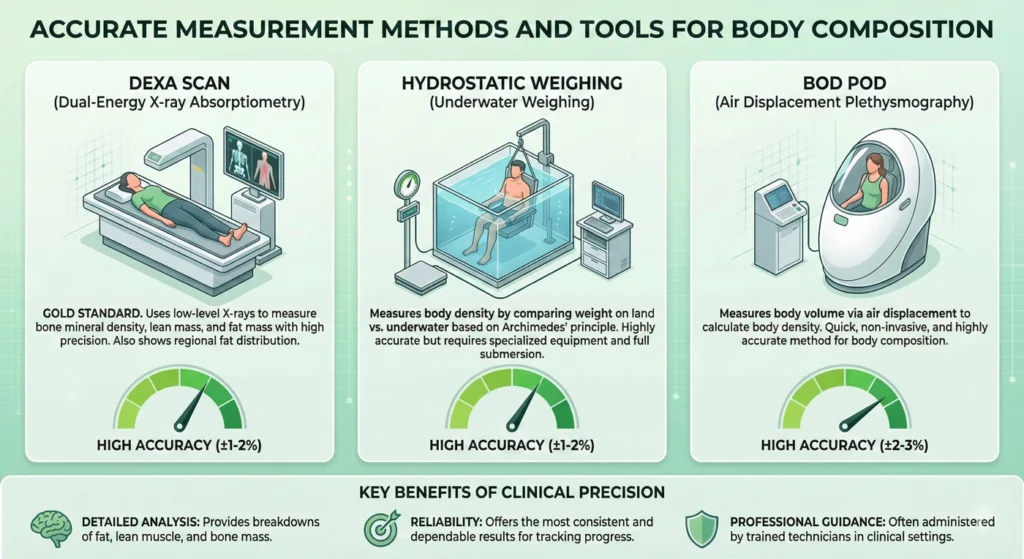
4. DEXA Scan
X-ray technology that measures bone density, fat, and muscle. Super accurate but expensive and requires a special facility.
5. Bod Pod
You sit in an egg-shaped chamber that measures air displacement. Pretty accurate and less awkward than some methods.
6. 3D Body Scanners
New tech that creates a 3D image of your body. Accuracy varies by the system.
7. Hydrostatic (Underwater) Weighing
This is the gold standard, folks. Let me break down how it works because it’s actually pretty cool.
The Science Behind Underwater Weighing:
So here’s the deal—this method uses Archimedes’ Principle (yeah, the “Eureka!” guy). Fat is less dense than muscle, so it floats more. When you weigh yourself underwater versus on land, the difference tells you your body density.
Here’s the basic process:
- You get weighed on a regular scale (weight in air)
- You sit on an underwater scale and exhale all your air
- You dunk yourself completely underwater while they measure
- They use the Siri Equation to calculate your body fat percentage from the density ratio
The formula looks something like this:
Body Density = Weight in Air / [(Weight in Air – Weight in Water) / Water Density – Residual Lung Volume]
Then they plug that into: BF% = (495 / Body Density) – 450
I know, I know—math. But the point is, this method is highly accurate when done properly.
Real-World Case Study: How the U.S. Navy Measures 400,000+ Service Members (And What This Teaches Us About Body Fat Assessment)
Okay, here’s something most people don’t know: the U.S. Navy has to assess the body composition of hundreds of thousands of personnel every year, often in challenging environments where fancy equipment isn’t available. So they’ve developed and refined a system that’s surprisingly sophisticated—and it teaches us a lot about what actually works for body fat measurement.
Why This Matters to You
The Navy can’t just use DEXA scans on everyone (imagine the cost and logistics), and they can’t rely on those bathroom BIA scales we talked about (too unreliable in military environments). They need something that’s accurate enough to make career decisions, fast enough for mass screening, and reliable enough to hold up in court if someone gets discharged for failing.
So what did they come up with? A three-step filtering system that gets more precise as it goes.
The Navy’s 3-Step Assessment Process
The genius of this system is that it doesn’t waste time on precision measurements for people who clearly pass or clearly fail. Instead, it uses increasingly accurate filters:
Step 1: The Weight Screen (The Quick Filter)
First, they check if you’re within the maximum weight for your height. This is basically a BMI proxy, but here’s the interesting part—they round your height UP to the nearest inch.
So if you’re 67.1 inches tall, they evaluate you as if you’re 68 inches. Since taller people get more weight allowance, this actually helps you pass. It’s a built-in bias toward letting people through.
If you pass this step, you’re done. No tape measure needed.
Step 2: The Abdominal Check (The Health Screen)
If you fail the weight screen, they don’t immediately fail you. Instead, they measure your waist at the top of your hip bones (iliac crest). Men need to be 39 inches or less, women 35.5 inches or less.
This step is brilliant because it recognizes that you might be heavy due to muscle mass, not fat. A powerlifter might weigh 220 pounds at 5’8″ (failing Step 1), but if their waist is 37 inches, they pass here and they’re done.
This measurement specifically targets visceral fat—the dangerous stuff around your organs that actually predicts health problems.
Step 3: The Full “Tape Test” (The Precision Calculation)
Only if you fail both previous steps do you get the full circumference measurement. And this is where it gets mathematically interesting.
For men, they measure:
- Neck (just below the Adam’s apple)
- Abdomen (across the navel—different from Step 2!)
For women, they measure:
- Neck
- Waist (narrowest point)
- Hips (widest point)
The Rounding System That Can Make or Break Your Score
Here’s where it gets wild. The Navy has a specific rounding system that actually helps you pass:
- All raw measurements are first rounded DOWN to the nearest 0.5 inch
- Neck measurements are then rounded UP to the nearest 0.5 inch (which lowers your calculated body fat)
- Waist measurements are rounded DOWN to the nearest 0.5 inch (which also lowers your calculated body fat)
This isn’t an accident. It’s designed to give people the benefit of the doubt and account for measurement variability.
Real Example:
Let’s say a guy measures:
- Neck: 16.25 inches → rounds to 16.0, then UP to 16.5
- Waist: 36.25 inches → rounds to 36.0, then DOWN to 36.0
His “circumference value” becomes 36.0 – 16.5 = 19.5 inches.
Now here’s the kicker: if he does neck exercises and increases his neck to 17.25 inches (which rounds to 17.5), his circumference value becomes 36.0 – 17.5 = 18.5 inches. That single change could drop his calculated body fat by 3-4%, moving him from failing to passing without losing a single pound.
The Math Behind the Madness
The formulas they use were developed in 1984 based on thousands of underwater weighing tests. For men:
%BF = 86.010 × log₁₀(abdomen – neck) – 70.041 × log₁₀(height) + 36.76
For women (more complex because it includes hips):
%BF = 163.205 × log₁₀(waist + hip – neck) – 97.684 × log₁₀(height) – 78.387
The key insight is that (abdomen – neck) difference for men, or (waist + hip – neck) for women. The bigger your neck relative to your trunk measurements, the lower your calculated body fat.
How Accurate Is This System Really?
When researchers compared the Navy method to DEXA scans (the gold standard), they found some interesting biases:
For men: The tape test tends to underestimate body fat by 2-4%. So if the tape says you’re 20%, you might actually be 22-24% on a DEXA scan.
For women: It tends to overestimate by 1-2%. A muscular woman with developed glutes might show higher on the tape test than she actually is.
The overall accuracy is around 3.5-4% error rate, which is actually pretty good for such a simple method.
Why Women Get Penalized
Here’s something that bothers me about the female formula: it adds waist + hips together. This means that a woman with muscular, developed glutes (which is healthy and athletic) gets penalized because her hip measurement drives up the calculated body fat percentage.
Meanwhile, men’s neck muscle actually helps them pass. It’s not exactly fair, but it explains why the Navy’s maximum allowable percentages are higher for women (34% vs 23% for the same age group)—they’re accounting for this measurement bias.
What About Those BIA Bathroom Scales?
The Navy case study actually explains why those bioelectrical impedance scales are problematic in real-world settings. In military environments, people are often dehydrated from training or hot climates. When you’re dehydrated, BIA scales encounter higher electrical resistance and interpret this as excess fat, potentially overestimating body fat by up to 8%.
That’s why the military sticks with tape measurements—they’re more consistent regardless of hydration status, what you ate, or when you last worked out.
How to Do the Navy Method at Home
If you want to try this yourself, here’s exactly how:
Equipment You Need:
- Non-stretchy fiberglass tape measure (cloth tapes stretch over time)
- Mirror (to check tape placement)
- Someone to help (measuring your own back is tricky)
For Men:
- Neck: Measure just below the Adam’s apple, looking straight ahead. Don’t hunch your shoulders or tuck your chin.
- Waist: Measure across your navel at the end of a normal breath out. Don’t suck in.
- Height: Measure accurately
- Use an online Navy calculator or the formula above
For Women:
- Neck: Same as men
- Waist: Measure at your narrowest point (usually between ribs and hip bones)
- Hips: Measure at the widest part of your glutes, feet together
- Height: Measure accurately
- Use the female Navy calculator
Pro Tips from Military Assessors:
- Take each measurement twice and average them
- Measure at the same time of day for consistency
- The tape should be snug but not tight enough to compress skin
- Don’t try to “game” the system—focus on actual fitness improvements
The Big Lesson for Civilians
What’s brilliant about the Navy’s approach is that it recognizes different levels of precision for different purposes:
- Quick screening (weight-for-height) filters out obviously fit people
- Health screening (abdominal circumference) identifies metabolic risk
- Precise assessment (full tape test) only when needed
You can apply this same philosophy:
- Use the Navy method for regular tracking
- Don’t obsess over the exact percentage—focus on trends
- If you need precision for medical reasons, get a DEXA scan
- Remember that performance and how you feel matter more than any number
Why This Method Survives Despite Criticism
The Navy method gets criticized a lot, especially by muscular people who fail it despite being lean. But here’s why it persists:
- It’s practical for large-scale screening
- It correlates well with health risks (abdominal circumference is a strong predictor)
- It’s consistent when done properly
- It’s cost-effective (no equipment needed beyond a tape measure)
The 2022 military policy update now allows high-performing personnel to exceed body fat standards if they excel on fitness tests. This acknowledges that the tape test, like all measurement methods, is just a proxy for what we really care about—health and performance.
Your Takeaway
The Navy method isn’t perfect, but it’s a solid tool for tracking trends over time. Use it as one data point along with:
- How your clothes fit
- Progress photos
- Energy levels
- Performance metrics
- How you feel
And remember: even the military—which has strict standards—recognizes that no single measurement tells the whole story about fitness and health.
The Truth About At-Home Body Fat Scales
Let’s talk about those fancy bathroom scales that promise to tell you your body fat percentage. You know, the ones that cost like $50-200 and supposedly do it all?
Here’s the honest truth: they can be off by 9-14%. Yeah, seriously. That’s a huge margin of error.
These scales use Bioelectrical Impedance Analysis (BIA), which sends a tiny electrical current through your body. The current moves faster through muscle (which has more water) than through fat. Sounds great in theory, right?
The problem is, they’re affected by EVERYTHING:
- How hydrated you are
- When you last ate
- If you’ve exercised recently
- Whether you’ve had coffee
- Time of day
- Temperature
- Whether Mercury is in retrograde (okay, kidding on that last one)
BUT—and this is important—they can still be useful for tracking trends over time. If you use the same scale, at the same time of day, under the same conditions, and you see the number going down consistently? That’s probably legit progress.
Just don’t trust the actual number. Use it for tracking changes, not absolute measurements.
Tools and Calculators That Actually Help
Look, I’m all about making this easier for you. There are some solid body fat percentage calculator tools online that can give you a ballpark estimate using measurements like your waist, neck, hip, and height.
The U.S. Navy Method is one of the most popular. You plug in your measurements, and it spits out a number. For example, you might get something like:
- Body Fat (U.S. Navy Method): 15.3%
- Body Fat Category: Fitness
Is it perfect? Nope. But it’s free, easy, and gives you a starting point. Combine this with progress photos and how your clothes fit, and you’ve got a pretty solid system for tracking changes without spending hundreds on fancy equipment.
Determining Your Healthy Body Fat Range
The Body Fat Percentage Charts You Actually Need
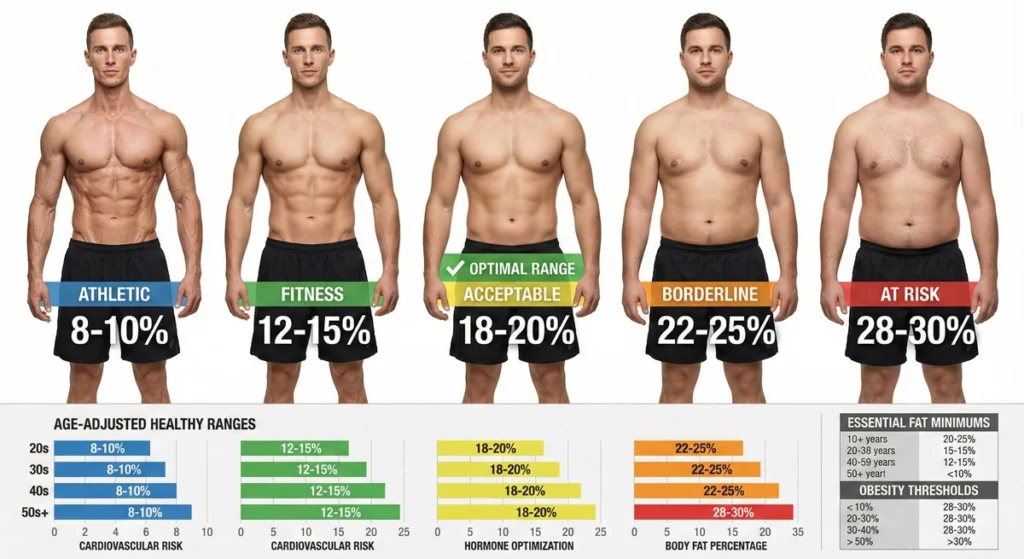
Okay, this is where rubber meets road. What’s actually healthy? What should you be aiming for?
For Men:
- Essential Fat (2-4%): This is survival mode. Bodybuilders might hit this for competition day, but you can’t live here.
- Athletes (6-13%): Professional athletes, fitness models. Very lean, abs for days.
- Fitness (14-17%): Healthy, active, you can see muscle definition. This is a great range for most guys.
- Acceptable (18-25%): Healthy but not super lean. Totally fine for general health.
- Higher Body Fat (26%+): Health risks may increase in this range.
For Women:
- Essential Fat (10-12%): Absolute minimum. Women need more essential fat than men for reproductive function.
- Athletes (14-20%): Elite athletes, very lean and defined.
- Fitness (21-24%): Healthy, active, toned appearance. Great range for most women.
- Acceptable (25-31%): Healthy range, just not as lean. Still totally healthy.
- Higher Body Fat (32%+): Health risks may increase in this range.
Sports-Specific Ranges:
Different sports have different “ideal” ranges. For example:
- Marathon runners: 5-11% (men), 10-15% (women)
- Wrestlers: 5-16% depending on weight class
- Volleyball players: 11-14% (men), 16-25% (women)
- Basketball players: 6-12% (men), 20-27% (women)
Here’s the thing though—these are just benchmarks. Your ideal body fat percentage depends on your goals, genetics, lifestyle, and what makes you feel good and perform well.
Advanced Strategies to Lower BF%
Nutritional Pillars for Actually Losing Fat (And Keeping It Off)
Alright, if your goal is to lower body fat percentage, let’s talk nutrition. And I’m not gonna feed you some fad diet BS. This is science-backed stuff that actually works.
The Calorie Truth:
Here’s what nobody wants to hear: permanent fat loss requires consistent caloric restriction. You gotta eat less than you burn. Period.
BUT—and this is a huge but—your calorie intake should never drop below your Resting Metabolic Rate (RMR). That’s the amount of energy your body needs just to keep the lights on. Go below that, and you’ll lose muscle tissue, deplete your glycogen stores, and basically sabotage yourself.
Use a body fat percentage calculator or RMR calculator to figure out your baseline, then create a modest deficit of 300-500 calories. Slow and steady wins this race.
The Macronutrient Triad (The Big Three):
1. Protein: Your New Best Friend
You need to consume enough protein to support muscle growth and repair. A high-protein diet does some magical things:
- Enhances appetite regulation (you feel fuller longer)
- Optimizes thermogenesis (your body burns more calories digesting it)
- Preserves muscle while you’re in a caloric deficit
Aim for about 0.8-1 gram per pound of bodyweight. So if you weigh 150 pounds, that’s 120-150 grams of protein daily.
2. Carbohydrates: It’s About the Type, Not Avoiding Them
Carbs aren’t evil. They’re your body’s preferred energy source. But here’s the strategy: focus on low Glycaemic Index (GI) foods—that means GI under 55.
These slow-burning carbs improve appetite regulation and delay hunger. Think:
- Beans and lentils
- Muesli and oatmeal
- Whole grain bread (the real stuff, not the “whole grain” that’s mostly white bread in disguise)
- Most fruits and non-starchy vegetables
- Quinoa and brown rice
Skip the white bread, sugary cereals, and processed snacks that spike your blood sugar and crash you an hour later.
3. Fats: The Good, The Bad, and The Essential
Trim the saturated and hydrogenated fats (fried foods, processed junk, most baked goods). But don’t go too low-fat either!
Include healthy fats rich in omega-3s:
- Fatty fish (salmon, mackerel, sardines)
- Walnuts and flaxseeds
- Avocados
- Olive oil
Why? Because low-fat diets can lead to deficiencies in fat-soluble vitamins (A, D, E, and K). Your body needs fat to function properly, especially your brain and hormonal system.
Optimizing Training for Fat Loss (The Exercise Blend)
Let’s talk about working out. If you want to increase your body fat percentage loss… wait, scratch that. If you want to decrease your body fat percentage (see what I did there?), exercise is your secret weapon.
The Lean Mass Strategy:
The most effective way to increase your RMR—and therefore burn more fat even while sitting on your couch—is to increase lean muscle mass. And you do that through a consistent high-intensity aerobic and weight training program.
Don’t worry, ladies—lifting weights won’t make you “bulky.” That’s a myth that needs to die. You’ll get toned, strong, and more efficient at burning fat.
Sample Weekly Training Plan:
Here’s a solid framework:
Monday: Upper Body Weight Training (UBWT)
- Push-ups, rows, shoulder presses, bicep curls, tricep dips
- 3-4 sets of 8-12 reps
Tuesday: Aerobic Training (AT)
- 30-45 minutes moderate intensity
- Running, cycling, swimming, or whatever you enjoy
Wednesday: Lower Body Weight Training (LBWT)
- Squats, lunges, deadlifts, calf raises
- 3-4 sets of 8-12 reps
Thursday: Aerobic Training (AT)
- Mix it up from Tuesday—maybe intervals or a different activity
Friday: Upper Body Weight Training (UBWT)
- Different exercises or rep ranges from Monday
Saturday: Active recovery or longer aerobic session
Sunday: Rest (seriously, rest)
Alternating weight training days helps maintain muscle mass while losing fat. This is KEY—most people who just diet and do cardio lose muscle along with fat, which tanks their metabolism.
Frequently Asked Questions
Is it safe to try to achieve very low body fat percentages?
Short answer? For most people, no.
Essential fat ranges are necessary for survival. Women need 10-12% minimum, men need 2-4%. These aren’t goals—they’re warning labels.
Going below essential fat can seriously mess with your hormonal function. Women can experience amenorrhea (loss of menstrual period), which isn’t just inconvenient—it can cause bone density loss and fertility issues. Men can experience testosterone crashes, mood issues, and decreased immune function.
Unless you’re a professional athlete prepping for competition (and working with a medical team), don’t try to live at extremely low body fat percentage levels.
Can supplements help lower body fat?
Man, I wish I could tell you there’s a magic pill. The supplement industry would love you to believe there is.
The truth? Most supplements that claim to burn fat are either ineffective or potentially dangerous. That “thermogenic” stuff? It’s basically just caffeine with some added ingredients of questionable value.
The most effective path involves consistent caloric restriction and the right nutritional and training strategy we talked about earlier. No shortcuts.
That said, some supplements can support your efforts:
- Protein powder (for hitting your protein targets)
- Creatine (for better workouts)
- Vitamin D and fish oil (if you’re deficient)
- Caffeine (if you need energy for workouts)
But none of these directly burn fat. They just help you stick to the actual things that work.
How does sleep affect body fat?
Oh man, this is huge and so many people ignore it!
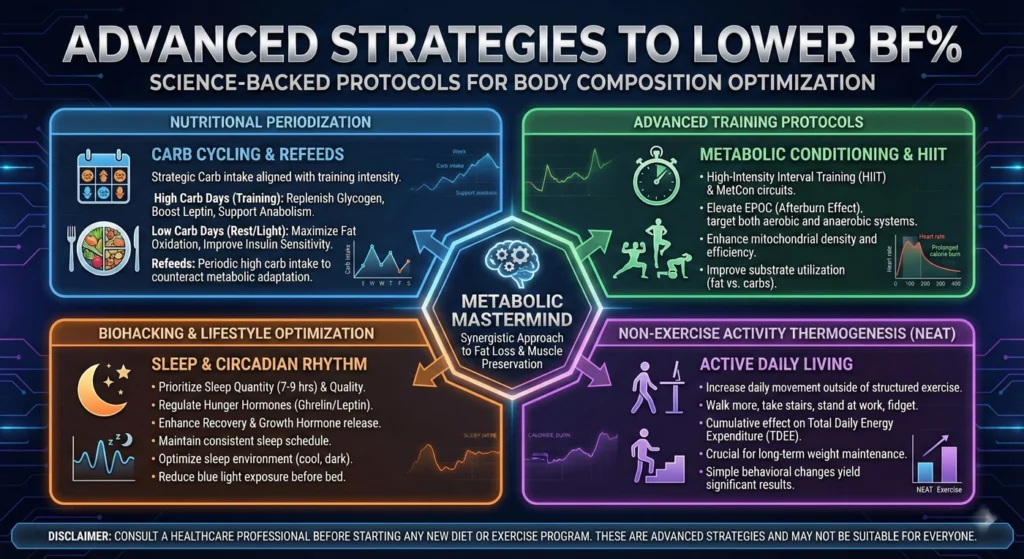
Good sleep and recovery are just as important as your workouts. Maybe more important. Your body does its best fat-burning and muscle-repairing work while you’re sleeping.
When you’re sleep-deprived:
- Your hunger hormones go haywire (more ghrelin, less leptin)
- Your cortisol stays elevated (cortisol promotes fat storage)
- Your insulin sensitivity decreases (harder to regulate blood sugar)
- Your workout performance tanks (so you burn fewer calories)
- Your willpower disappears (hello, late-night snacking)
Aim for 7-9 hours of quality sleep. It’s not lazy—it’s strategic.
Final Takeaway: It’s All About the Big Picture
Look, your body weight is just one piece of a much bigger puzzle. Success isn’t about getting to some magic number on the scale or hitting a specific body fat percentage and stopping.
It’s about tracking trends in:
- Your body composition over time
- Your diet quality and consistency
- Your sleep patterns
- Your exercise habits
- Your energy levels
- How your clothes fit
- How you feel
Genetics play a role too, so stop comparing yourself to Instagram fitness models who might have completely different body types, genetics, and (let’s be real) photo editing apps.
Your Call to Action:
Start where you are. Pick one thing from this post to implement this week:
- Maybe it’s using a body fat percentage calculator to get your baseline
- Maybe it’s adding one strength training session to your week
- Maybe it’s swapping your sugary cereal for oatmeal with berries
- Maybe it’s just committing to 8 hours of sleep
You don’t have to overhaul your entire life overnight. Small, consistent changes compound into major results over time.
And if you want personalized strategies, consider working with a registered dietitian or certified personal trainer who can design a program specifically for your body, goals, and lifestyle. Sometimes investing in professional guidance saves you months or years of spinning your wheels.
Remember: the best body fat percentage for you is the one that lets you live your healthiest, happiest, most energetic life. Not the one that looks good in a magazine or matches some arbitrary standard.
Now get out there and start tracking what actually matters. Your future self will thank you.
References:
U.S. DoD + Navy policy & procedures (primary sources)
- U.S. Department of Defense. (2022). DoD Instruction 1308.03: DoD Physical Fitness and Body Fat Programs. DoD Issuances. https://www.esd.whs.mil/DD/
(This is the overarching DoD-level policy that authorizes approved body composition assessment approaches and sets service-wide guardrails.) - U.S. Navy. OPNAVINST 6110.1 (series): Physical Readiness Program (PRP). (Most current revision). Navy Issuances / Navy Personnel Command.
https://www.secnav.navy.mil/doni/ (or via Navy Personnel Command PRP page)
(This is the top-level Navy instruction behind the Physical Readiness Program, under which the BCA sits.) - Navy Personnel Command (NPC). (Most current). U.S. Navy Physical Readiness Program Guide 4: Body Composition Assessment (BCA). NPC Physical Readiness Program resources.
(This is the practical “how to run it” document: step sequence, measurement sites, and rounding rules.)
Tip: If you want a stable citation in your article, cite it as “NPC PRP Guide 4 (current edition)” and link the PRP resource page where the PDF lives.
Foundational equations and body composition science (supports the math)
- Hodgdon, J. A., & Beckett, M. B. (1984). Prediction of percent body fat for U.S. Navy men and women from body circumferences and height. Naval Health Research Center.
(This is the original technical basis for the Navy circumference equations widely reproduced in military guidance and calculators.) - Siri, W. E. (1956). The gross composition of the body. In J. H. Lawrence & C. A. Tobias (Eds.), Advances in Biological and Medical Physics (Vol. 4, pp. 239–280). Academic Press.
(Supports the density-to-body-fat conversion commonly referenced with hydrostatic weighing and related models.)
“Gold standard” context and measurement best practices (DEXA, densitometry)
- Nana, A., Slater, G. J., Hopkins, W. G., & Burke, L. M. (2015). Effects of daily activities on dual-energy X-ray absorptiometry measurements of body composition in active people. Medicine & Science in Sports & Exercise, 47(1), 192–199.
(Useful for explaining why even DEXA has standardization requirements and can vary with hydration/food/training.) - Ackland, T. R., Lohman, T. G., Sundgot-Borgen, J., et al. (2012). Current status of body composition assessment in sport. Sports Medicine, 42(3), 227–249.
(A widely cited review comparing methods like DEXA, Bod Pod, hydrostatic weighing, skinfolds—helpful for your “accuracy vs practicality” discussion.)
BIA limitations (hydration sensitivity)
- Kyle, U. G., Bosaeus, I., De Lorenzo, A. D., et al. (2004). Bioelectrical impedance analysis—part I: review of principles and methods. Clinical Nutrition, 23(5), 1226–1243.
- Kyle, U. G., Bosaeus, I., De Lorenzo, A. D., et al. (2004). Bioelectrical impedance analysis—part II: utilization in clinical practice. Clinical Nutrition, 23(6), 1430–1453.
(Together: strong sources for “BIA varies with hydration, recent exercise/food, etc.” and why field conditions can skew readings.)
Waist/abdominal circumference and health risk context (why Step 2 exists conceptually)
- World Health Organization (WHO). (2008). Waist Circumference and Waist–Hip Ratio: Report of a WHO Expert Consultation. WHO.
https://www.who.int/publications/
(Supports the idea that central adiposity/waist metrics are meaningful for cardiometabolic risk—i.e., why a waist screen is used operationally.)
Civilian classification benchmarks used for comparison (ACE/ACSM)
- American Council on Exercise (ACE). (Most current). Body Fat Percentage Norms / Categories. ACE resources.
https://www.acefitness.org/
(Supports the “Essential/Athlete/Fitness/Average/Obese” BF% category framing.) - American College of Sports Medicine (ACSM). (Most current edition). ACSM’s Guidelines for Exercise Testing and Prescription. Wolters Kluwer.
(Supports broader norms/health framing around body composition and related risk stratification.)